
October 2, 2026
Build a flexible 1600-calorie day with measured portions, checked food swaps, seven-day meal ideas, and grocery quantities. Learn what changes with each swap.
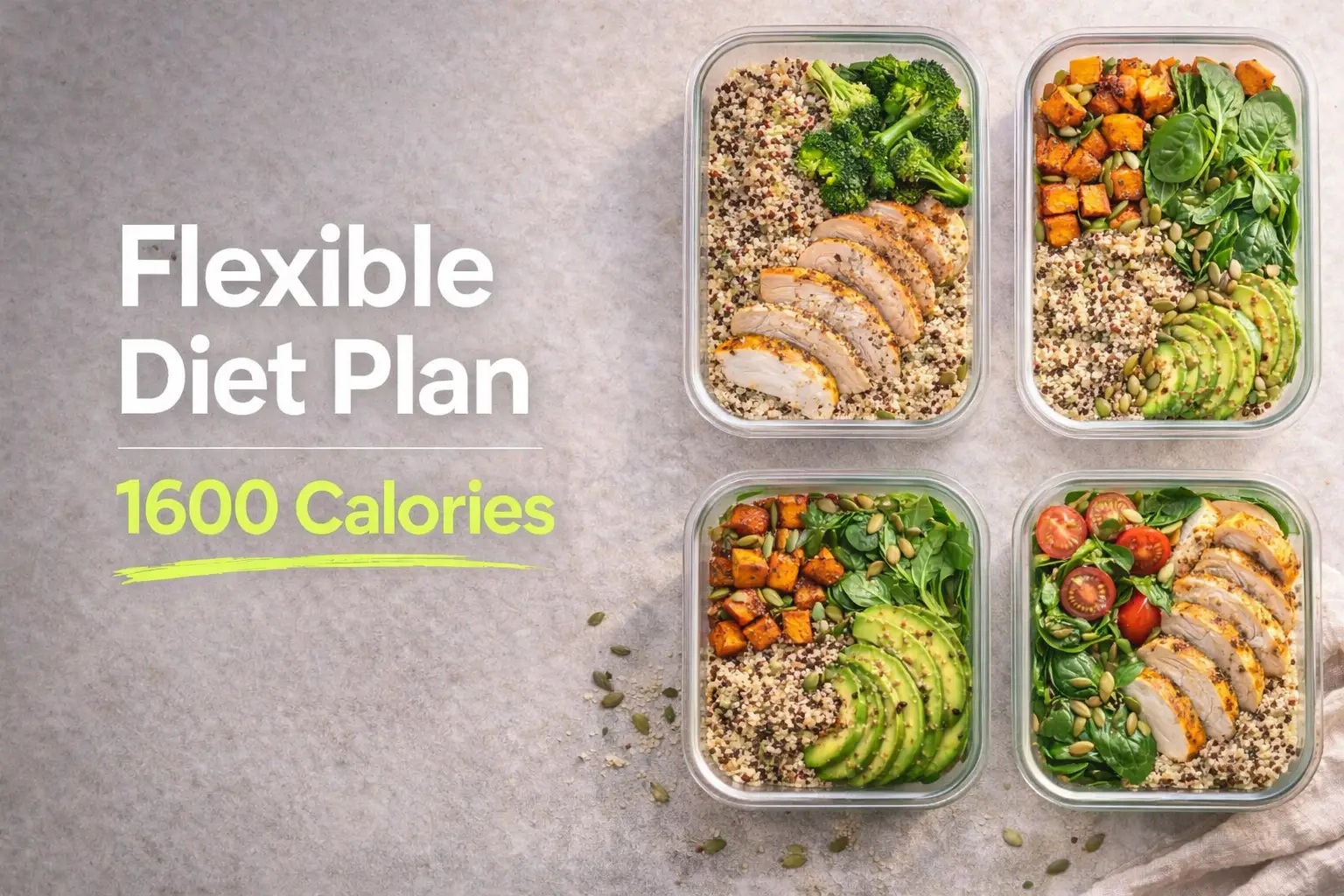
A 1600 calorie flexible meal plan uses repeatable meals and checked substitutions instead of requiring seven completely different days. Below is one measured day, food-swap examples, a seven-day idea rotation, and matching shopping quantities. Flexibility means knowing what changes when you replace a food—not assuming every bowl, wrap, or handful has the same nutrition.
Start with food you enjoy and a routine you can repeat. Keep a dependable breakfast, prepare a lunch base, and leave room to change dinner. If precision matters, check the replacements once and save the portions rather than doing the same calculation every morning.
This is general education for adults, not a clinician-reviewed prescription or a diabetes exchange plan. A 1600 calories a day meal plan does not automatically cause weight loss or meet your needs. Age, body size, activity, health, and other factors affect energy requirements. A smaller number is not inherently better.
Do not use this worksheet as a calorie target for children or teens, pregnancy, breastfeeding, or eating-disorder recovery. With a medical condition, prescribed diet, medication that affects eating, or persistent symptoms, get individualized professional guidance. Do not change medication to fit the meals. If the plan leaves you persistently hungry or low on energy, reassess the intake rather than trying to suppress hunger.
This example makes portion arithmetic visible. It is not a complete assessment of vitamins, minerals, fiber, or your individual needs. It deliberately repeats a chicken-and-rice base so the shopping calculation is easy to follow; the rotation below offers other dishes without pretending they have identical nutrition.
Calculations use specific USDA FoodData Central SR Legacy records archived on October 9, 2026. FDC IDs are 173904 (dry oats), 170894 (plain nonfat Greek yogurt), 173944 (banana), 171477 (roasted chicken breast, meat only), 168878 (cooked white long-grain rice), 169967 (boiled, drained broccoli without salt), 171413 (olive oil), 170567 (almonds), and 169097 (orange). Brands and cooking methods can differ.
40 g dry oats, 200 g plain nonfat Greek yogurt, 100 g peeled banana. Approximately 359 calories and 26.7 g protein.
120 g cooked skinless chicken breast, 170 g cooked white rice, 150 g cooked broccoli, 8 g olive oil. Approximately 542 calories and 45.4 g protein.
100 g cooked skinless chicken breast, 180 g cooked white rice, 200 g cooked broccoli, 10 g olive oil. Approximately 557 calories and 40.6 g protein.
15 g almonds and 120 g peeled orange. Approximately 143 calories and 4.3 g protein.
Cook or prepare the foods using appropriate recipes and package instructions. Add the measured oil to the bowl or plate so the worksheet assumes it is eaten, rather than estimating oil left in a pan. Cook oats with water, cool as appropriate, and add yogurt and banana; extra milk or toppings are not included. Sauces and drinks must be counted separately if used.
The unrounded totals are 358.60 + 542.22 + 557.40 + 143.25 = 1,601.47 calories, with about 117.0 g protein. Rounded meal numbers will not always sum to the rounded daily number. This is a database estimate, not a measurement of your actual plate.
For a visual alternative to numbers, see how to build a balanced plate. You can also move the snack alongside a meal; four eating occasions are not required.
For flexible meal planning, first decide why you are changing the food: preference, allergy, convenience, cost, energy, or protein. Then check the replacement. A calorie match is not proof of equal fiber, sodium, micronutrients, or fullness. Never use an allergen just because its numbers match.
100 g peeled banana supplies 89 calories in the selected record. 189 g peeled orange supplies 88.83 calories. This is a near energy match, not equal fruit weight: replacing 100 g banana with 100 g orange would supply 47 calories instead. In the breakfast example, the 189 g orange replaces the banana; it is not an additional snack.
10 g olive oil supplies 88.4 calories; 15 g almonds supplies 86.85 calories and about 3.2 g protein. For a suitable bowl or salad, almonds could replace the measured oil as a topping. They are not a cooking-oil substitute in every recipe, and this option is unsuitable with a nut allergy. Adding both is a different meal, not the same swap.
100 g cooked chicken breast supplies 165 calories and 31.02 g protein. About 304 g plain nonfat Greek yogurt supplies 179.36 calories and 30.98 g protein. You could serve yogurt as a separate savory side, if you enjoy it; it does not need to imitate chicken. This is a protein comparison, not an instruction to eat a large yogurt portion or a dairy-free alternative.
If you specifically wanted to keep the worksheet energy almost unchanged, reducing cooked rice by 11 g would remove 14.3 calories. The net change would be about +0.06 calories before rounding. This optional arithmetic is not a reason to compensate for every small food difference. Recheck the whole meal's protein too: removing rice also removes a little protein.
Tofu, beans, eggs, fish, and cottage cheese can provide other options, but no exact equivalence is claimed here. Use a specific product or recipe rather than the food name alone. A high protein 1600 calorie meal plan still needs an appropriate individual protein target; the example's 117 g is not a universal recommendation.
The FDA's Nutrition Facts guide explains that nutrients refer to the stated serving and that the label serving is not a recommended intake. Compare the same amount or scale it deliberately.
Write down the food, preparation state, grams, calories, and protein. Keep oils, dressings, and toppings in the calculation. Once a meal works for you, save that version; change the saved numbers when the brand or recipe changes. For more breakfast or snack variety, the portion-based Greek yogurt ideas show practical combinations without claiming they all have the same totals.
These preserve the original guide's weekly variety while separating ideas from verified nutrition. Choose recipes, suitable portions, and any needed swaps before calling a day a 1600 calorie diet plan. Only Day 1 uses the measured worksheet above; no exact calorie or protein totals are assigned to Days 2–7.
A wrap, smoothie, curry, and salad can have very different ingredients and portions. Swap a complete meal using its actual recipe totals rather than assuming that lunch automatically equals lunch. For practical assembly, see the beginner's guide to cooking ahead.
This list covers three repetitions of Day 1 for one adult—not the seven-day idea rotation. Multiply the amount used, then subtract usable stock before deciding what to buy.
For shopping, convert cooked chicken, rice, and broccoli to raw or dry purchases using the yield of your recipe or package. There is no universal raw-to-cooked factor in this worksheet. Fruit purchases must allow for peel, and olive oil here is weighed in grams, not measured in milliliters.
For example, a 1 kg yogurt tub leaves 400 g after the 600 g planned use. With 50 g oats already in the pantry, you need 70 g more for the 120 g total. If replacing the banana on all three mornings with the checked orange portion, remove 300 g peeled banana and add 567 g peeled orange. Including the original orange snacks, the new orange requirement is 927 g edible fruit.
Record those changes in your organized grocery list before shopping. If organizing meals is where you get stuck, PlanEat AI on the App Store can help with planning; still verify portions and suitability rather than treating a generated number as medical advice.
Prepare the base foods, divide them into the portions you intend to use, and keep fresh toppings separate. Plan another cooking session or freeze suitable later portions promptly rather than expecting a week's food to remain safe in the refrigerator.
USDA guidance for leftovers recommends refrigerating perishable leftovers within two hours, or one hour above 90°F/32°C. Use shallow containers, keep the refrigerator at 40°F/4°C or below, use refrigerated leftovers within three to four days, and reheat leftovers to 165°F/74°C. Follow product-specific storage instructions too; portioning does not extend shelf life.
No. Energy needs vary, and 1,600 calories may be too little or otherwise unsuitable. This guide is an educational portion worksheet for adults, not a prescription or a promise of weight loss. Get individualized advice for medical conditions, pregnancy, breastfeeding, or an eating-disorder history.
You can reuse meals and portions you have already checked rather than recalculate every ingredient daily. That reduces repeated work, but eyeballing different foods cannot guarantee a 1,600-calorie total. Use your labels and actual portions when accuracy matters.
Yes, if the food suits you, but equal weights are not automatically equal in calories or protein. Choose the purpose of the swap, check the product or recipe, and recalculate the portion. Beans and tofu also vary by preparation; yogurt is not a dairy-free option.
No. Only the measured example day is calculated here, at about 1,601 calories using the listed USDA records. The seven-day rotation provides meal ideas, not verified daily totals. Choose recipes and portions before treating any rotation day as a calorie-counted menu.
For the calculated day, weigh rice, chicken, and broccoli after cooking; oats are dry and fruit weights exclude peel. Shopping starts with raw or dry ingredients, so use the actual recipe yield to convert. Do not substitute the same number of grams raw for cooked.
Do not keep shrinking portions to protect the number. Reconsider whether the target meets your needs and seek qualified advice, especially with symptoms, medication, or heavy activity. A higher intake or a different approach may be appropriate; this article cannot determine it for you.
Use measured portions as a reusable worksheet, distinguish calorie and protein swaps, and update purchases when ingredients change. A flexible plan must fit your needs, not force you to fit a number.